Why good books are at the heart of our Core Programs
There’s something lovely about a book becoming part of family life.
A character’s name finds its way into conversation. A phrase becomes a family joke. Your child asks for the same story again, even though everyone knows what happens. Weeks later, something you see on a walk reminds you of a page you read together.
The book has finished, but the thinking and talking continue.
At Simply Homeschool, we love that a good book can be both a pleasure in itself and the beginning of something more. That’s why our Core Programs are built around Great Books, Big Ideas and Real Life.
Stories give us a reason to care
Children encounter plenty of information as they learn. A story gives that information somewhere to belong.
Through a character, a place or a problem, children have something to care about. They want to know what happens next. They wonder why someone made a particular choice, how something works, or whether the same thing could happen in their own lives.
A book about a journey might spark an interest in maps. A story set beside the sea might lead to questions about tides or the creatures living in rock pools. A character facing an unfair situation might start a thoughtful conversation about fairness, courage and speaking up.
Those questions offer a natural starting point for learning. We can follow them into research, writing, experiments, art and everyday conversations.
Good books make room for different perspectives
Books invite us into lives beyond our own.
We might meet a character whose family looks familiar, or one whose experiences are very different. We might visit another time or place, encounter an unfamiliar tradition, or see an ordinary situation through someone else’s eyes.
For children, there can be comfort in recognising themselves in a story. There can also be value in discovering that other people experience the world differently.
Our Wonder Core Program, for example, explores this through R. J. Palacio’s story of Auggie, a boy who looks different from others and is starting school for the first time. His experiences invite children to think about friendship, belonging, empathy and kindness.
The learning extends into exploring points of view, writing short stories and plays, and portraying a character onstage. Children have opportunities to consider how a situation might look and feel to someone else, then bring that understanding into their own creative work.
Reading together also gives families room to pause and talk.
Why do you think she did that?
How might he have felt?
Do you agree with what happened?
There doesn’t always need to be a neat answer. Sometimes a good conversation begins with a question everyone is still thinking about.
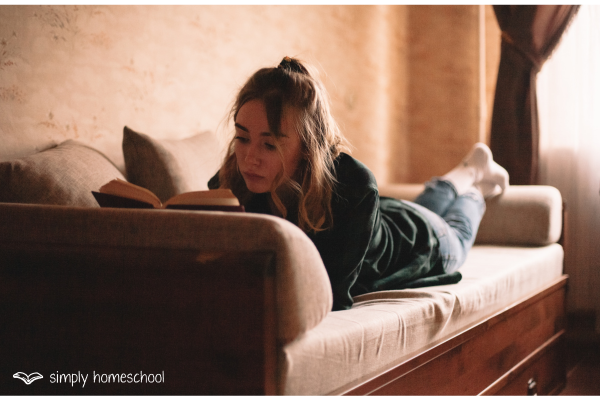
Rich language belongs to everyone
Books offer children language they may not hear in everyday conversation: an unusual word, a beautiful description, a funny turn of phrase or a sentence that makes them hold their breath.
They show what words can do.
Children can enjoy that language even when reading independently is difficult. Listening to a parent read aloud, sharing the reading or using an audiobook can make a story accessible without every word becoming a decoding task.
A child’s ideas and interests may be far ahead of the texts they can comfortably read alone. Sharing books gives them access to stories worth thinking about while their reading skills continue to develop.
And reading aloud doesn’t have to stop when children can read for themselves. Older children can still enjoy the shared experience, the conversation and the chance to simply listen.
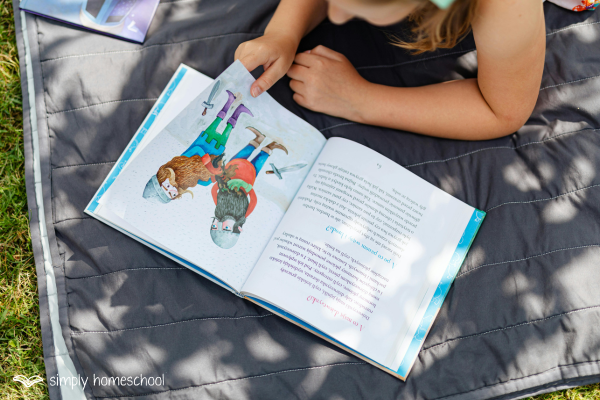
A book can open doors into other subjects
A good book gives us many possible directions to explore.
In our Tim Tie-Your-Shoelaces! Core Program, playful storytelling opens up opportunities to explore both language and science. Children investigate onomatopoeia, invented words and how fonts contribute to a story, then explore the urban water cycle and water treatment.
The book gives children a reason to look closely at how a story is told, and to become curious about how the world around them works.
In our Katie and the Sunflowers Core Program, a story becomes an invitation to discover art and language. Children observe the post-impressionist artworks found in the book, experiment with their own art and enjoy a gentle introduction to French.
They practise French through skits and create a new art adventure book following Zazou’s story, incorporating the language they’ve been learning. Pronunciation guides from a native speaker provide support along the way.
Art appreciation, language, performance and storytelling connect through a shared adventure. Children can revisit what they’ve discovered in different ways: looking, listening, speaking, making and imagining.
For older learners, The Book Thief Core Program brings English, History and Art together through an exploration of the power of stories.
It includes literary analysis, character development and advanced creative writing, alongside studying the Holocaust and the power of propaganda. Learners investigate how artists affect their viewers, build a timeline of events, and create and publish their own picture book - even planning a book launch.
The book provides a starting point for serious questions about history and language, as well as opportunities to become creators themselves.

Why build a Core Program around a book?
Our Core Programs offer a homeschooling curriculum library for families. Each takes a book as its starting point and builds a world of activities, projects, discussion and discovery around it.
Rather than presenting a collection of disconnected tasks, we can explore ideas that relate meaningfully to something a child has read, heard or seen. A question raised in a story can lead to an investigation. An illustration can inspire an artwork. A character’s choices can become the starting point for writing or discussion.
Our Core Programs help families take those possibilities further, with quality books, hands-on learning and meaningful experiences that encourage children to explore ideas in depth.
They also give parents somewhere to begin without needing to invent every next step themselves.
A shared book also doesn’t mean every child needs to have the same experience.
One may be fascinated by the illustrations. Another wants to understand the history. Someone has strong opinions about a character’s decision, while someone else wants to make, build or draw something inspired by the story.

Leave room to love the story
We also believe books deserve to be enjoyed without every page becoming an assignment.
Sometimes you’ll follow a question into a whole afternoon of discovery. Sometimes you’ll choose a Core activity and see where it leads. Sometimes you’ll curl up together, read the next chapter and leave it there.
A child doesn’t have to produce something to show that a story mattered.
The pleasure of reading, the closeness of sharing it and the thoughts that surface afterwards are valuable parts of childhood, too.
That’s what we want to make room for at Simply Homeschool: good books enjoyed together, with thoughtful opportunities to explore the ideas they open up.
A story can stay with a child for years. We love helping families discover where it might take them.